Welcome to the online lecture BPMN Meets DMN: Business Process and Decision Modeling
Dear students,
we welcome you to our course that will start on April 11th, 2016. This online course introduces concepts of business process modeling using BPMN (Business Process Model and Notation) and decision modeling using DMN (Decision Modeling and Notation). A sample BPMN model is shown below that describes the process of an insurance claim handled by an insurance company. It shows also the interaction with the client who raised the claim. Further, it shows a task which decides whether the claim is covered or not. How the decision is made, is not explicitly shown in this process. During the course, we will also learn how to express decision logic in DMN.
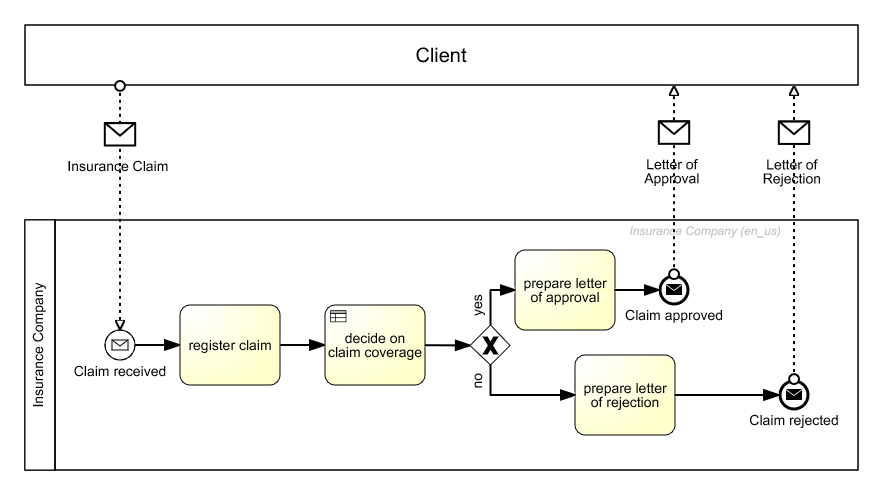
Model of an insurance claim handling process with a decision on the claim coverage
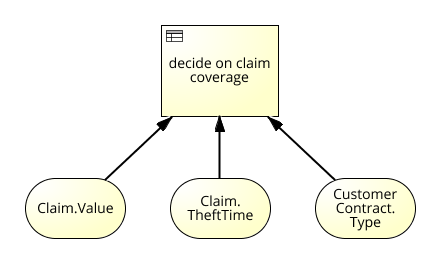
Decision Model for the decide-on-claim-coverage decision
Participants will learn the elements of process models and their precise meaning. During the course, we will also look at techniques to analyze business processes both from a qualitative and a quantitative perspective. Finally, participants will learn about decision models including the design of decision requirements and logic and how they are connected to business processes.
The course topics are also covered and further elaborated on in the textbook Business Process Management – Concepts, Languages, Architectures" by Mathias Weske. The publisher offers 50% discount on the electronic version and 20% discount on the print version of this book for the participants of this course.
Additional to the course material, we also provide you modeling tasks and a peer review to work on your own modeling skills. For modeling business processes, a modeling tool is very helpful. Here we recommend the Signavio Online Editor which we explain in detail here.
Course Overview
The course is organized in six chapters; each chapter is covered in one week. Hence, over the course of six weeks, the lecture teaches the following topics.
Introduction to Business Process Management (Week 1)
This chapter covers the background to modeling business processes including their role in modern organizations. The business process lifecycle outlines, how business process models are designed, implemented, and run in an organization.Basic Business Process Modeling (Week 2)
Following the definition of business process models – a set of activities that are performed in coordination and contribute to a business goal – this chapter covers the basics of process modeling, that is, activities, sequence flows, events and gateways, which allow to define rich execution semantics for process models.Analyzing Process Behavior (Week 3)
In order to carry out business processes in an organization, they shall be analyzed first: to find potential errors and estimate their performance and cost. Therefore, we introduce methods to detect behavioral anomalies such as deadlocks, which cause the process to get stuck or fail. Simulation serves as a means to validate the process with respect to its procedure and outcome.Advanced Business Process Modeling (Week 4)
Based on the results of week 2, we introduce further concepts to business process models. For example, sub-processes allow decomposing process models in a hierarchical fashion and activity modifiers provide to express more intricate execution semantics, which assist in keeping the model's structure both concise and coherent. The chapter will also focus on the distribution of work to resources of a companies, which is one of the key benefits of running business processes.Data in Process Models (Week 5)
Although business processes are essentially models of behavior, data is key in their execution. That is, data is provided as input to activities and leads to the desired outcome. Hence, it is necessary to include data dependencies in process models and to ensure their consistency with the control flow of the business process.Business Decision Modeling (Week 6)
Business decisions are very important in the context of business processes as the decision output influences the flow, performance and quality of a business process. This chapter covers the basics of decision modeling based on the new DMN (Decision Model and Notation) standard. It introduces how decision requirements are captured and how the decision logic can be defined. Further, it discusses possibilities to check the consistency between decision models and business processes.
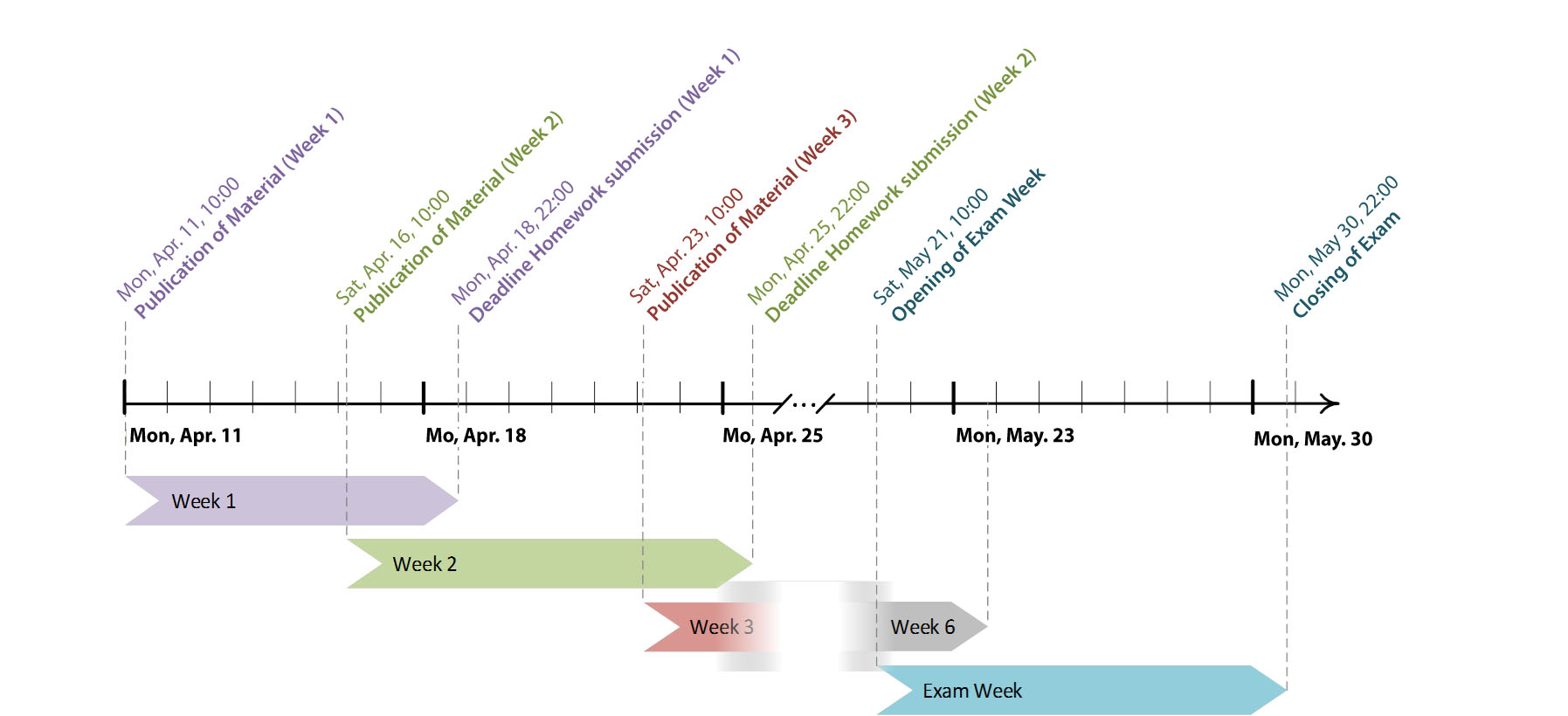
To participate in the course, you are expected to watch the lecture videos, study the material and submit homeworks every week. The course material will be published on Saturdays before the week starts (except in week 1) and homeworks must be submitted before 10pm (UTZ+2) on Mondays of the subsequent weeks. The following figure sketches the schedule of our course. All times are given in Central European Summer Time (UTC+2).
Teaching Team
This online course is provided by the Business Process Technology group at HPI (http://bpt.hpi.uni-potsdam.de).
Professor Mathias Weske is chair of the group and regularly holds lectures on business process management, decision management, and event processing at HPI.
Luise Pufahl is a research assistant and PhD candidate at the group since 2012. She received her Master of Science degree in Business Informatics at the Humboldt University of Berlin.
Kimon Batoulis is a research assistant and PhD candidate at the group since 2014. He received his Master of Science degree in IT-Systems Engineering at the University of Potsdam.
Julian Weise is a bachelor student at HPI in IT-Systems Engineering and student assistant at the group since 2015.