An error occurred while loading the video player, or it takes a long time to initialize. You can try clearing your browser cache. Please try again later and contact the helpdesk if the problem persists.
To enable the transcript, please select a language in the video player settings menu.
Welcome to the "Sustainability in the Digital Age" series
Digital systems offer a great opportunity to significantly reduce carbon emissions and can contribute to the efficient use of energy. However, all systems also need energy. This area of tension is addressed in the course: Sustainability in the digital age - Energy-Efficient Software Development. To effectively reduce the carbon footprint of digitalization, it is necessary to apply algorithmic efficiency and sustainability by design as guiding principles in digital engineering. We will introduce strategies to develop software that prioritizes minimized energy consumption through optimal coding and green testing practices. We will look at how the CO2 emissions of operating software applications can be measured and calculated. How to measure the performance and energy consumption of Large Language Models will be covered as well. Further we share approaches how to use advances in hardware technology and operate digital systems efficiently in data centers based on eco-friendly and cost-effective capacity management strategies.
This course is part of the Sustainability in the Digital Age series, a collaborative project between colleagues from Stanford University, SAP and the Hasso Plattner Institute.
Language: English
English, Deutsch
Cloud and Operating Systems, Enterprise Computing, Intermediate, Programming
Course information
Digital systems enable real world energy efficiency. However, every digital action requires energy. The use of digital technologies has increased exponentially over the last couple of decades and therefore also its energy requirements - this is especially true for such popular applications as artificial intelligence and media streaming.
To reduce the energy requirements of computer systems it is necessary to:
• Raise awareness about the energy footprint of computer systems
• Find feasible methods to measure and calculate the energy consumption of computer systems and software
• Take the trade-off between performance and energy consumption into account when creating computer systems
• Establish algorithmic efficiency in digital engineering
• Use advances in hardware technology
• Operate digital systems efficiently in data centers
• Implement eco-friendly and cost-effective capacity management strategies
Course Structure
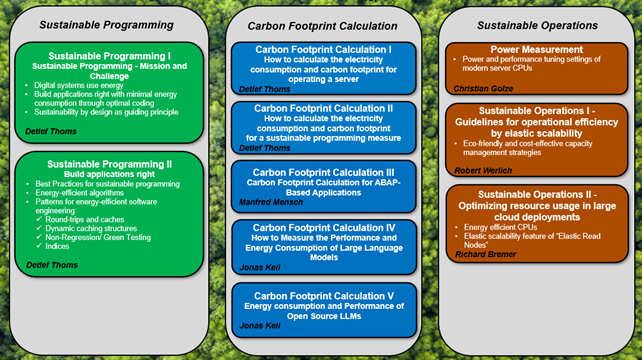
The course is based on three pillars:
• Sustainable Programming
• Carbon Footprint Calculation
• Sustainable Operations
Scope
The Sustainability in the digital age - Energy-Efficient Software Development course runs for two weeks with a total workload of approximately 3-4 hours. It includes around 10 videos (12-15 minutes each). This course does not have self-tests after each video.
All learning materials are available from the start of the course. The final exam is activated at the end of the first week and remains open until the course ends, giving participants two weeks to complete the content and one week for the exam.
Software engineers can achieve success not only through the features they build but also through the energy they save!

Enroll me for this course
Learners
Certificate Requirements
- Gain a Certificate by earning at least 50% of the maximum number of points from all graded assignments.
- Gain a Confirmation of Participation by completing at least 50% of the course material.
Find out more on our page for certificates and guidelines.
Our teachers

Detlef Thoms
Detlef Thoms is Chief Product Expert, Performance & Scalability at SAP Product Engineering and holds 26 years of SAP experience that he has gained in several areas like Development Support, Supply Chain Management Consulting and Solution Management for Master Data Governance. In January 2011 he joined the Performance & Scalability Team covering the entire SAP portfolio with the focus to ensure that SAP software is performance-optimized, sustainable, and designed to capitalize on the latest hardware and technology trends.
“Software engineers can achieve success not only through the features they build but also through the energy they save!”
Manfred Mensch
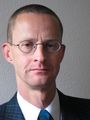
Manfred Mensch studied physics and mathematics at the University of Karlsruhe. He received his PhD in environmental physics from the University of Heidelberg. After further years of research in the US and in Germany, he joined SAP in 2000 and has been a member of the Performance and Scalability team since 2006. His responsibilities include supporting his colleagues in SAP’s Product Engineering and Technology & Innovation organizations by coaching and consulting on performance during the design, implementation, and maintenance phases of their software. Currently, Manfred is focusing on the development of training programs and on performance measurement and analysis tools.

Jonas Keil
Jonas Keil is a former VT/Star Student in Business Information Technology at SAP SE and is currently pursuing a Master’s degree in Business Information Technology at the University of Potsdam. His recent work focuses on Large Language Models, and how to evaluate their performance, energy consumption and key energy drivers. His Bachelor’s thesis, titled “Benchmarking the Energy Consumption During Inference of Open-Source Large Language Models,” was graded summa cum laude.

Christian Golze
Christian Golze studied physics and earned a Ph.D. before joining SAP's Performance & Scalability team in 2008. He started his work with ERP performance and refined his focus to load testing and benchmarks with the advent of the SAP HANA database. In his role as development expert, he is responsible for the benchmarking toolkit used internally and by SAP's partners for validation and sizing by applying modern mixed OLAP/OLTP S/4HANA workloads.

Robert Werlich
Robert Werlich is a senior developer and performance expert at SAP’s Performance & Scalability Team. He joined as a member of the team and SAP in 2019 and is located in Walldorf. His focus is the support of colleagues in SAP’s Product Engineering organization for analysis of CDS View Performance by consulting and coaching on performance in the implementation and maintenance phase of their applications. Another topic is the implementation of dynamic capacity adjustments of our SAP HANA databases and ABAP application services for our cloud customers running S/4HANA.
Richard Bremer
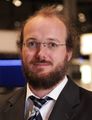
Richard Bremer studied physics at the Universities Aachen and Edinburgh and received his PhD in high-energy physics from RWTH Aachen University. He joined SAP in 2008, focusing on SAP’s in-memory technologies with roles in support and product management, then joined the product management for SAP S/4HANA, being responsible for scalability options for large systems and since 2024 is leading SAP’s Performance & Scalability team.