Overview
The second week (Basic Business Process Modeling) of our online course will introduce essentials of process modeling using BPMN (Business Process Model and Notation). At the end of this chapter, you will be able to understand and formulate business process models using activities, gateways, and events.
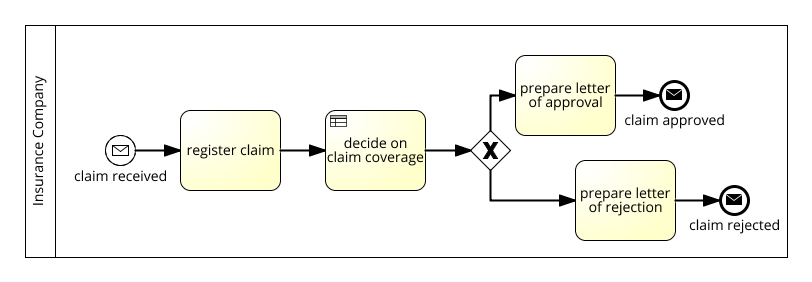
The concepts and practices to model a business process are explained by means of a running application scenario that will be extended step by step. You can read the complete scenario and a sample business process model here.
The second week of the course consists of six lecture clips which address the following topics.
- Fundamentals of Modeling Languages BPMN conveys both a structure, the process model graph that consists of a composition of symbols, and the meaning of that structure, i.e., the behavior expressed by the model. In general, this is captured by the notation, syntax, and semantics of a modeling language.
- Process Activities Activities are the central aspect of a process as they represent the units of work that are conducted in coordination. The order, in which these activities shall be executed is determined by sequence flow, directed arcs that connect activities. During enactment, each activity instance traverses a number of states that represents the status of its completion.
- Exclusive and Parallel Gateways
Sequence flow arcs, solely, can express sequences of activities. However, in many cases it is desirable to execute activities only if some condition holds. Furthermore, some activities may not depend on each other and could be executed in any order or even concurrently. BPMN gateways are means to split the control flow and realize these extensions. - Inclusive Gateways and Loops
Exclusive and parallel gateways are sufficient to capture the behavior of the majority of business processes. Loops, for example, can be modeled using an exclusive gateway that routes the sequence flow back to an earlier position in the process model. However, sometimes more intricate execution semantics are required. The inclusive gateway allows choosing any number of paths based on expressive conditions. - Start Events and End Events
Events demarcate changes in the environment of a business process. As such, there exist events that trigger the start of a business process and events that determine its termination. Different kinds of events allow for specific events to be caught or thrown, e.g., the reception of a message, the expiration of a timer, or the occurrence of an error. - Intermediate Events
Events can also be caught or thrown during the process execution, e.g., if some information needs to be received from an interaction partner, before the process can continue. Such events are called intermediate events. They can also be used to cancel activities, e.g., if an activity takes too long or produces an error, some exception handling shall be conducted rather than continuing with the regular process flow.
Organization
You can find several self tests , by which you can check your learning progress. There is no time limit or submission deadline for these tests and you receive direct feedback on your answers. You can even repeat them.
At the end of the week, you need to submit a homework . For the homework you should calculate 30-45 minutes and the homework has a time limit (60 minutes) . Please be advised that this test can only be started ONCE (closing the browser does not stop the timer). In addition, the homework starts when you click on the start button on the homework page . So, only click on the button if you are willing to take the assignment. The achieved score in the homework contributes to your total score for this course. You will be informed about your results and a sample solution is published a day after submission deadline.
In case you have questions regarding the lectures, self tests, or assignments, please use the community forum. Often these questions can be answered by your fellow students. Members of the teaching team also read the questions in the forum and help, whenever help is needed. We are looking forward to fruitful discussions.
Enjoy the second week!
Weekly Schedule
Please be aware of the following dates for this week.
- The homework needs to be submitted by April 25th, 2016, at 22:00 (10:00 pm) CET. Submission is already open; after consulting the lecture material (videos, slides, and reading material), you can start on the homework right away.
- The solution for this week's homework will be published on Tuesday, April 26th , 2016, at 10:00 (am) CET.
- The material for the next week , covering Basics of Business Process Modeling, will be made available on Saturday, April 23th , 2016, at 10:00 (am) CET.
- All times are Central European Summer Time (UTC+2). Please check your local time zone. The remaining time until April 25th, 2016, at 22:00 (10:00 pm) can be checked at the provided link.
Reading Material
- Chapter 4.7 of the book Business Process Management – Concepts, Languages, Architectures and covers the main elements of BPMN discussed this week.
- The BPMN Version 2.0 specification document can be obtained from the Object Management Group. It is the single definition and central reference for questions with respect to the modeling language.
- For a brief overview of BPMN, you can download a poster that shows the majority of elements on a single page. At http://www.bpmb.de/index.php/BPMNPoster you find poster (PDF) in many languages. The page also gives information on how to get a free copy of a large printed poster.
- http://www.workflowpatterns.com/ provides a complete set of patterns related to business process management. With respect to the topics covered in Week 2, control flow patterns are most relevant. The majority of practically relevant patterns are provided in the BPMN, but the list of control flow patterns at http://www.workflowpatterns.com/ is much more comprehensive. The patterns are animated, so it is really worth taking a look at.
- I briefly discuss the issues related to the inclusive OR Join in one of this week's video clips. Ekkart Kindler shows the fundamental problems of this control flow construct in his paper "On the semantics of EPCs: A framework for resolving the vicious circle". This is very interesting reading for those who like to know more about this challenging academic question.