An error occurred while loading the video player, or it takes a long time to initialize. You can try clearing your browser cache. Please try again later and contact the helpdesk if the problem persists.
Learn to build simple but effective prototypes, prepare testing scenarios and gain valuable feedback from potential users. This course introduces you to the basics of prototyping, planning and running real testing scenarios.
Language: English
English
Beginner, Intermediate
Course information
This course introduces you to helpful skills for making an idea tangible and testing it with potential users. We take a task-based approach to build these skills. You will learn to take an idea to the next level and build a simple prototype, plan a testing scenario and collect feedback.
This MOOC builds on the 2018 “From Synthesis to Creative Ideas” course, but you can also take it as a stand-alone MOOC. The assignments are designed for individual work.
Learning Objectives
- build simple prototypes for user testing
- plan and conduct user testings
- cluster and analyze tester feedback
- evaluate tester feedback
- evaluate the quality of your peers' work and provide constructive feedback
Course Structure
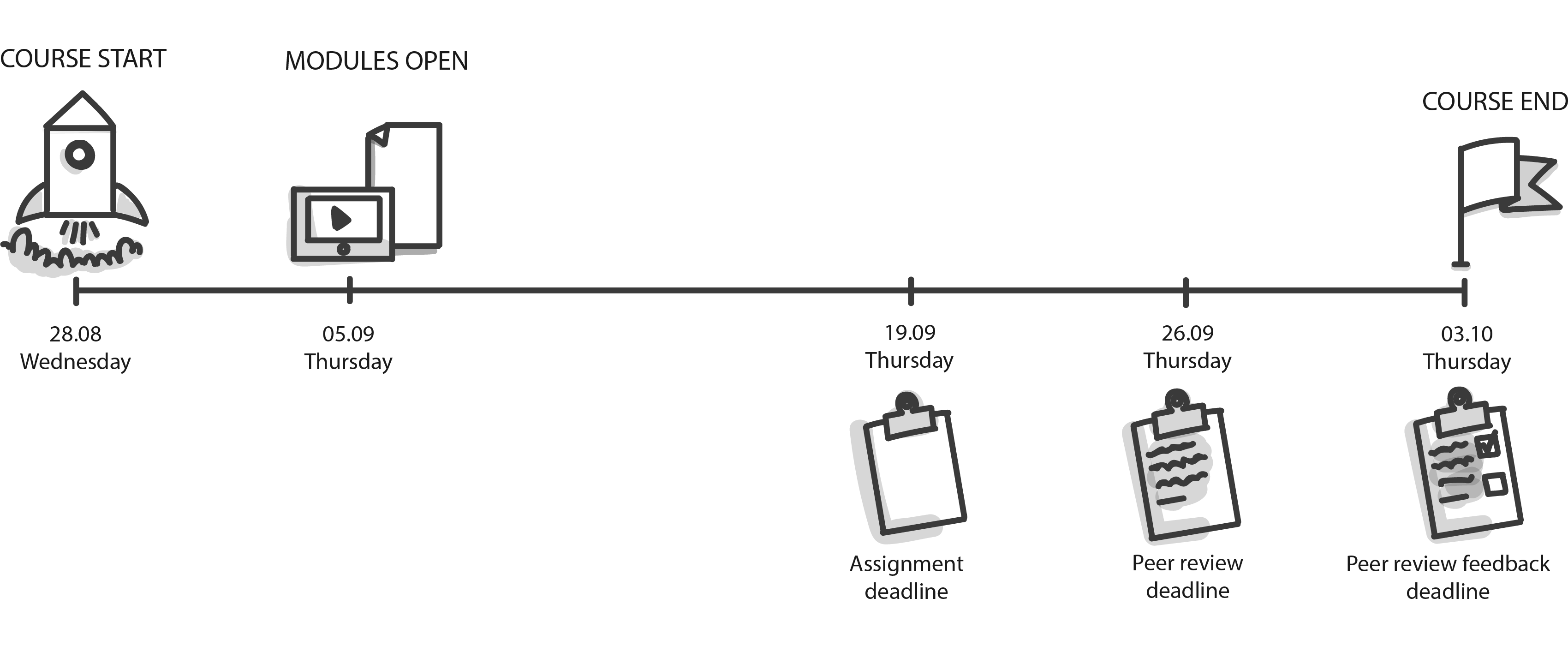
WELCOME AND INTRODUCTION / Week 1 (28.8. – 4.9.2019)
During the welcome week, you have the chance to introduce yourself and to discover the learning environment with a warm-up game.
Time commitment: 1h – 1:30h
PROTOTYPING / Week 2 (5.9. – 11.9.2019)
In this week, we focus on prototypes: why and how do we build them? You will learn about going from an idea to a prototype, different types of prototypes, and prototyping techniques.
Time commitment: 3h – 4h
TESTING / Week 3 (12.9. – 19.9.2019)
In this week, we focus on the skill of conducting user tests with prototypes. You will learn to prepare a testing scenario, to structure tester feedback, and to filter aspects for iteration.
Time commitment: 3,5 - 5h
WRAP UP / Week 4 (and beyond) (19.9. – 26.9.2019)
During the wrap-up week, we provide a summary of the course content. We will discuss assignment results, showcase assignment examples, and describe the next steps in a design thinking project.
Time commitment: 0:30h – 1h
Target Audience
This course is best suited for those who are curious about design thinking and human-centered approaches for building and testing prototypes. No prior knowledge is required. This course is designed for individual work; it is not necessary to find a team of co-participants. However, we encourage you to interact with peers. Your online peers will review your work.
Voices of HCD: From Synthesis to Creative Ideas
“I have already changed my own way of working since I started learning about human-centered design.”
“I already work in the field of Design Thinking, but this course confirmed me in my work.”
“I will incorporate the design thinking mindset in the next project I will be working on to come up with a more customer oriented solution!”
“The course and format are both excellent.”
Former MOOCs
You can find our first two MOOCs here:
Note
This course is part of a research project that investigates the potentials and challenges of teaching design thinking in an online environment. Therefore your participation in the course surveys and feedback are very valuable to us.
Attention: This course is currently in self-study mode, in which you do not have access to graded assignments/exams. Therefore, we can only issue you a certificate of participation.
Enroll me for this course
Learners
Certificate Requirements
- Gain a Certificate by earning at least 50% of the maximum number of points from all graded assignments.
- Gain a Confirmation of Participation by completing at least 50% of the course material.
Find out more on our page for certificates and guidelines.
Our teachers

Karen von Schmieden
Karen von Schmieden is a PhD candidate in the HPI-Stanford Design Thinking Research Program and a curator and editor of ThisIsDesignThinking.net. She has worked as a journalist and in a startup for radio technology. Karen is an alumna of the HPI School of Design Thinking, where she designed human-centered solutions in projects for Charité Berlin and the Rundfunk Berlin-Brandenburg. She studied in Maastricht, Istanbul and Lisbon and holds an M.A. in European Studies on Society, Science and Technology. She’s a co-founder of the student-led innovation group „Maastricht Disrupt“.

Mana Taheri
Mana Taheri is a PhD candidate at the HPI-Stanford Design Thinking Research Program. Her research interests lie in the fields of e-learning and cultural diversity. In her research projects she investigates the potentials and challenges of teaching design thinking at scale and to a global audience with diverse cultural backgrounds. Mana is also a member of the teaching team at the HPI School of Design Thinking in Potsdam, Germany. She is well experienced in designing and leading workshops in various international settings, from Tehran, to Berlin, and to Havana. Mana was born and raised in Tehran, where she earned a Bachelor’s degree in Economics before moving to Berlin to complete her Master’s in Economics and Management at Humboldt University.

Lena Mayer
Lena Mayer is a PhD candidate at the HPI-Stanford Design Thinking Research Program. Her research interests lie in organizational training and (virtual) team collaboration. Lena also works as a freelance design thinking coach for organizations and universities. She graduated from Maastricht University with a M.Sc. in Work and Organizational Psychology and is currently also following a further education program in systemic communication. In the past, she has worked in several interdisciplinary design projects, as a tutor and in the field of consultancy.