Overview
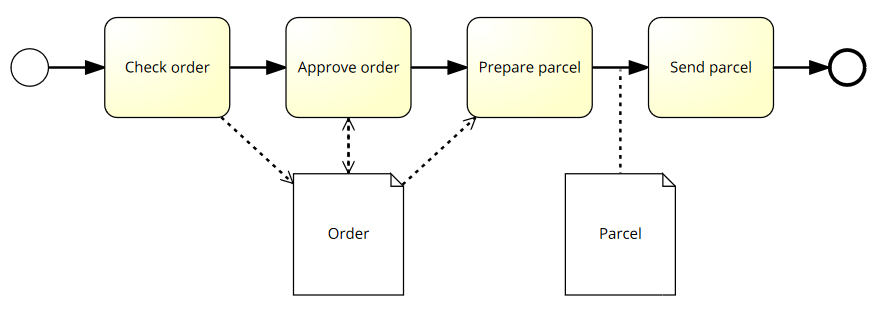
Business processes are essentially models of behavior. However, the execution of a business process is driven by data. BPMN allows incorporating data objects into process models, as well as relating them as input and output of activities and processes. The fifth week covers Data in Business Processes and discusses the capabilities of BPMN with regard to modeling data in business processes.
The lecture comprises five video clips.
- Organizing Process Models In an organization, the output of one process model is used as the input of another, which leads to a supplier/customer-relationship between business processes, for which requirements can be defined. Such relations also exist between the processes of different organizations. An example are vendor parts which are used as input for the production process of a car manufacturer.
- Data and Data Flow Data is key to execute business processes, that is, data is created, manipulated, and used during process enactment; it serves as input and is produced as output of business processes. BPMN allows modeling data objects and their state, as well as associating them to activities.
- Data Execution Semantics
Data objects drive the execution of business processes, as an activity can only be executed if all required input data is available and is the basis for taking decisions (data-based exclusive gateway). In process models, it is possible to define data requirements precisely and to relate data objects to persistent storages, e.g., database systems. - Structured Data and Sub-Processes
Data collections are lists of data objects. With the help of multiple instance activities (see week 4), it is possible to iterate over the elements of a collection and process them one by one. If parts of a process are encapsulated in sub-processes, data is handed over to the child process by input data, where it is processed and returned to the parent process. - Object Lifecycle Conformance Data objects may have an internal lifecycle of the states, e.g., an order needs to be created and confirmed before it can be fulfilled. It is important that the data object lifecycle and the treatment of a data object in a business process conform to each other. Informally, data object lifecycle conformance requires that the business process does not introduce states or state transitions of the data object that are not defined for the latter.
Consistency of Process and Data
Data objects may exhibit states and an internal lifecycle of the states, e.g., an order needs to be created and confirmed before it can be fulfilled. This lifecycle can be derived from the processing of the data objects in a business process.Object Lifecycle Coverage
It is important that the lifecycle and the treatment of a data object in a business process are consistent. Informally, coverage requires that the process does not skip any state in the lifecycle of a data object.Object Lifecycle Conformance
Complementary to object lifecycle coverage, conformance requires that the business process does not introduce states or state transitions of the data object that are not defined for the latter.
Organization
As usual, there are a number of self-tests , to check your understanding of the lectures.You have as much time as required to solve these tests, you can take them at any time and arbitrarily often.
Please recall: At the end of the week, you need to submit a homework. You should calculate 30-45 minutes for the homework which has a hard time limit of 60 minutes. Please note that this test can only be started ONCE (closing the browser does not stop the timer). In addition, the homework starts when you click on the start button on the homework page. So, only click on the button if you are willing to take the assignment. The achieved score in the homework contributes to your total score for this course. You will be informed about your results and a sample solution is published a day after the submission deadline.
If questions arise with regard to the lectures, self tests, or assignments, please use the community forum.
Have fun!
Weekly Schedule
Please be aware of the following dates for this week.
- The homework needs to be submitted latest by May 16th , 2016, at 22:00 (10:00 pm) CET. Submission is already open; after consulting the lecture material (videos, slides, and reading material), you can start on the homework right away.
- The solution for this week's homework will be published on Tuesday, May 17th , 2016, at 10:00 (am) CET.
- The material for the final lecture week , covering Business Decision Modeling, will be made available on Saturday, May 14th , 2016, at 10:00 (am) CET.
- All times are Central European Summer Time (UTC+2). Please check your local time zone. The remaining time until May 16th, 2016, at 22:00 (10:00 pm) can be checked at the provided link.
Reading Material
- Practical aspects of business process management and the improvement of process interfaces are presented in a German book by Füermann and Dammasch: Prozessmanagement: Anleitung zur ständigen Prozessverbesserung. 3. Auflage, Hanser 2008.
- Data objects, data flow and data object states are standardized in the BPMN version 2.0 specification in section 10.3.
- Data-related concepts in BPMN are also discussed in condensed form in the book Business Process Management – Concepts, Languages, Architectures in section 4.7
- Object lifecycle conformance was introduced by Küster, Ryndina, and Gall: Generation of Business Process Models for Object Life Cycle Compliance. BPM 2007: 165-181. The paper can be found at http://scholar.google.de/citations?view_op=view_citation&hl=de&user=rQwUZewAAAAJ&citation_for_view=rQwUZewAAAAJ:WF5omc3nYNoC